
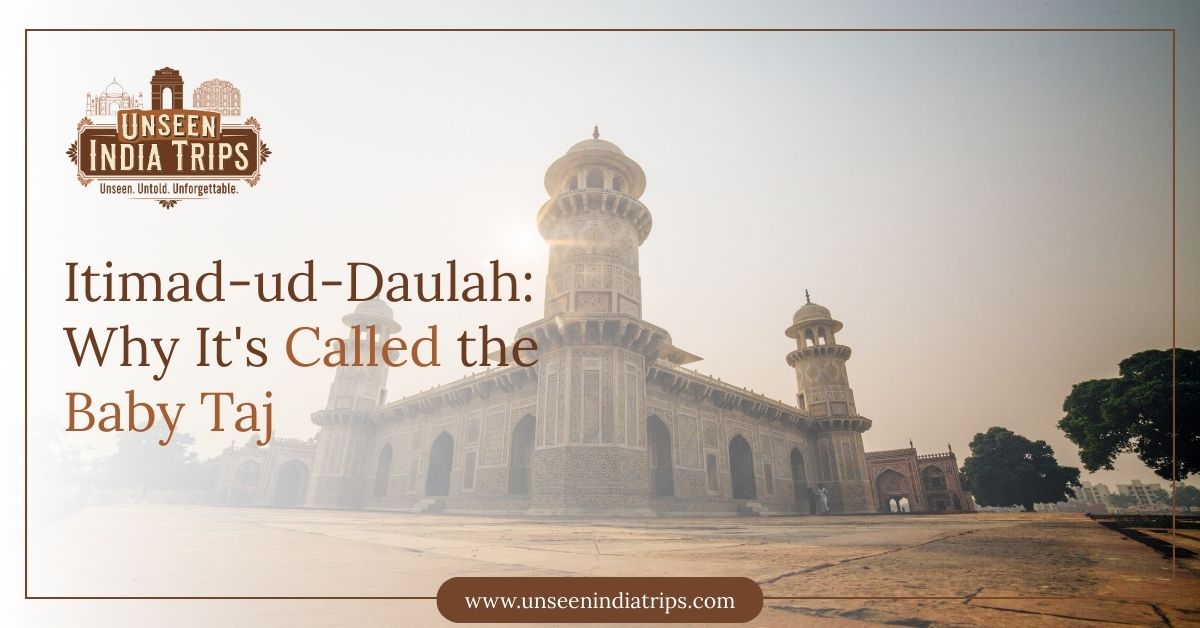
Along the banks of the Yamuna River in Agra stands a marble monument that tourists often overlook in their rush to visit the Taj Mahal. Yet Itimad-ud-Daulah, affectionately known as the “Baby Taj,” represents a crucial evolution in Mughal architecture and tells a touching story of a daughter’s love for her father. For those exploring Agra through a same day Agra tour by car, this exquisite tomb offers an intimate, less crowded alternative experience that reveals the artistic innovations that would later culminate in the Taj Mahal.
The Story Behind the Monument
Itimad-ud-Daulah was built between 1622 and 1628 by Nur Jahan, the powerful wife of Emperor Jahangir, as a mausoleum for her father, Mirza Ghiyas Beg, and her mother. Ghiyas Beg held the title “Itimad-ud-Daulah,” meaning “Pillar of the State,” reflecting his position as one of the most important nobles in Jahangir’s court. He rose from humble Persian immigrant to become the empire’s chief treasurer and the emperor’s father-in-law when his daughter Nur Jahan married Jahangir.
The tomb represents the first Mughal structure built entirely of white marble and the first to make extensive use of pietra dura (stone inlay work)—techniques that would reach their zenith in the Taj Mahal two decades later. Nur Jahan personally oversaw the tomb’s design and construction, making it one of the few major Mughal monuments with documented female patronage. Her artistic vision created something unprecedented—a departure from the red sandstone traditions of earlier Mughal architecture toward the ethereal white marble aesthetic that defines later Mughal monuments.
Unlike the grand scale of the Taj Mahal, Itimad-ud-Daulah charms through delicacy and intimacy. This smaller scale doesn’t diminish its importance; rather, it allowed for more intricate decoration and finer detail work than would be practical on a larger structure. Every surface features elaborate decoration, making it perhaps the most densely ornamented of all Mughal buildings.
Architectural Innovations and Design
The tomb sits within a walled garden measuring approximately 100 by 100 meters, following the traditional Persian char bagh (four-garden) layout that symbolizes paradise in Islamic tradition. The garden, divided by water channels into four quarters with the tomb at the center, creates a serene environment that enhances the monument’s contemplative beauty.
The main tomb structure measures about 21 square meters and stands three stories tall, though it appears delicate rather than imposing. Four octagonal towers rise from each corner, topped with marble cupolas (chattris) that echo Persian architectural traditions. The building represents a transition between earlier Mughal tomb designs and the iconic form that the Taj Mahal would later perfect.
The ground floor contains the actual burial chambers of Itimad-ud-Daulah and his wife, positioned in the center of the structure. The simplicity of these underground chambers contrasts sharply with the elaborate upper floors, following Islamic traditions emphasizing humility in death despite worldly accomplishments.
The first floor houses the cenotaphs (ornamental tombs) visible to visitors. These markers, exquisitely decorated with pietra dura inlay, represent where the deceased symbolically rest, though the actual graves lie below. The cenotaphs feature geometric and floral patterns in semi-precious stones—cornelian, jasper, lapis lazuli, onyx, and topaz—creating designs so intricate they appear painted rather than carved.
The Art of Pietra Dura
What truly distinguishes Itimad-ud-Daulah and earns it the “Baby Taj” nickname is its pioneering use of pietra dura inlay work. This technique, imported from Italy but adapted with Persian and Indian motifs, involves cutting semi-precious stones into thin slices, shaping them precisely, and fitting them into marble surfaces to create pictures or patterns.
The tomb’s exterior features cypress trees (symbolizing death and eternity), wine flasks (representing life’s pleasures), and geometric patterns covering every surface. The interior decoration becomes even more elaborate—walls, ceilings, and floors showcase floral bouquets, vases, fruits, and abstract geometric patterns executed with extraordinary precision. Some flowers measure just centimeters across, yet contain dozens of separate stone pieces fitted together seamlessly.
The color palette includes yellows, blues, greens, and reds against white marble backgrounds, creating visual richness without overwhelming garishness. The colors have faded slightly over four centuries, but remain remarkably vibrant, a testament to the stones’ quality and the craftsmen’s skill in protecting the inlay work.
The lattice screens (jali) in the tomb demonstrate another artistic achievement. Carved from single marble blocks, these screens feature geometric patterns that allow light and air to pass while maintaining privacy—practical solutions to India’s hot climate while creating beautiful light effects inside the tomb. The play of sunlight through these screens changes throughout the day, transforming the interior atmosphere from morning to evening.
Persian Influences and Cultural Fusion
Nur Jahan’s Persian heritage strongly influenced the tomb’s design. The pavilions with four-column supports, the emphasis on garden settings, and the extensive use of marble reflect Persian architectural traditions her family brought from Iran. Yet the monument also incorporates Indian elements—the chattris atop towers, the jali screens, and some decorative motifs derive from indigenous building traditions.
This cultural fusion characterizes much of Mughal art and architecture. The Mughals, originally from Central Asia, ruled India by adapting to local conditions while maintaining connections to Persian and Central Asian cultures. Monuments like Itimad-ud-Daulah embody this synthesis, creating something unique to the Indian subcontinent yet recognizably connected to broader Islamic architectural traditions.
The inscriptions throughout the tomb, executed in elegant Persian calligraphy, include Quranic verses and poetic couplets praising the deceased. The choice of text, its placement, and its execution demonstrate the importance of poetry and refined language in Mughal court culture, where artistic expression through words held equal importance to visual artistry.
Why “Baby Taj”?
The “Baby Taj” nickname emerged in the 20th century as tourism developed in Agra. The name serves multiple purposes—it’s catchy, helps tourists remember the monument, and accurately conveys its relationship to the Taj Mahal. However, the diminutive term somewhat diminishes the tomb’s historical significance and artistic merit.
“Baby Taj” implies a lesser version of the main monument, but art historians argue Itimad-ud-Daulah deserves appreciation on its own terms rather than merely as a precursor. The tomb pioneered techniques and aesthetic choices that the Taj Mahal later employed on a grander scale, making it in some ways more innovative than its famous successor.
The tomb influenced the Taj Mahal’s design in specific ways. Shah Jahan, Nur Jahan’s nephew, would have known Itimad-ud-Daulah intimately, having grown up during its construction. When he built the Taj Mahal for his wife Mumtaz Mahal three decades later, he employed the white marble aesthetic, pietra dura inlay, char bagh layout, and riverside setting pioneered at Itimad-ud-Daulah, expanding and perfecting these elements on a monumental scale.
Visiting Experience Today
Modern visitors to Itimad-ud-Daulah find a strikingly different atmosphere from the Taj Mahal. While the Taj attracts thousands daily, Itimad-ud-Daulah receives perhaps hundreds, making it possible to enjoy the monument peacefully, sometimes with only a handful of other visitors present. This quieter experience allows for closer examination of the intricate inlay work and more contemplative appreciation of the gardens.
The monument sits about five kilometers north of the Taj Mahal, easily accessible by the same day Agra tour by car that most visitors use to navigate Agra’s attractions. The journey takes about 20 minutes, making it feasible to visit both monuments in a single day along with Agra Fort.
Photography enthusiasts particularly appreciate Itimad-ud-Daulah. The smaller scale allows capturing the entire monument in frame more easily than the Taj Mahal’s vast proportions permit. The intricate inlay work photographs beautifully in close-up, and the relative absence of crowds means freedom to find optimal angles without dodging other tourists.
The gardens, though smaller than those of the Taj Mahal, remain beautifully maintained with seasonal flowers and manicured lawns. The Yamuna River, visible from the monument though reduced from historical flow levels, adds to the peaceful atmosphere. Early morning or late afternoon visits offer the best light for photography and the most comfortable temperatures during hot months.
Conservation Challenges and Efforts
Like all historical monuments in Agra, Itimad-ud-Daulah faces conservation challenges. Air pollution from vehicles and nearby industries threatens the marble, causing yellowing and surface deterioration. The Archaeological Survey of India conducts regular maintenance, including careful cleaning of surfaces and stabilization of structural elements where necessary.
The pietra dura inlay requires particular attention. Over time, the adhesive materials securing the stone pieces degrade, causing pieces to loosen or fall out. Conservators painstakingly replace lost pieces using traditional techniques and materials as close to the originals as possible. This work continues year-round, often in sections to minimize impact on visitor experience.
Water damage from seasonal rains and previous flooding of the Yamuna River has affected the foundations and lower walls. Drainage systems have been improved to prevent water accumulation, and humidity control measures protect the interior from moisture damage that could compromise both structural integrity and decorative elements.
Cultural and Historical Significance
Beyond its architectural importance, Itimad-ud-Daulah represents several significant historical developments. It documents the rise of a Persian immigrant family to the highest levels of Mughal power, illustrating the cosmopolitan nature of the empire that valued talent regardless of ethnic origin. Mirza Ghiyas Beg’s success story—from impoverished refugee to imperial treasurer—exemplifies the meritocratic aspects of Mughal administration.
The monument also showcases women’s agency in Mughal society. While Mughal women typically lived in purdah (seclusion), powerful women like Nur Jahan wielded considerable influence. Her ability to commission and oversee such an important architectural project demonstrates that elite Mughal women could exercise power in public spheres, albeit through specific channels.
For visitors racing through Agra to check the Taj Mahal off their bucket lists, Itimad-ud-Daulah offers a chance to slow down and appreciate architectural artistry without overwhelming crowds. Its intimate scale allows for closer examination of craftsmanship that gets lost in the Taj Mahal’s vast proportions. Understanding this “Baby Taj” enriches appreciation of its more famous descendant, revealing how artistic innovations evolve and culminate in masterpieces.