
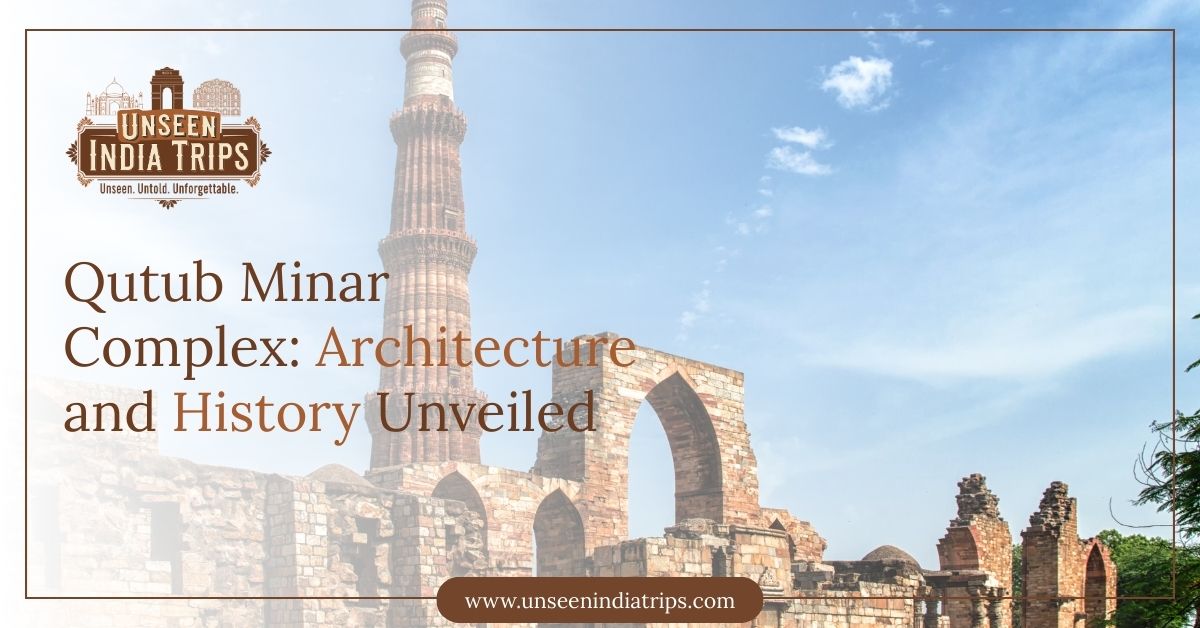
Standing tall at 73 meters, the Qutub Minar Complex represents one of Delhi’s most iconic monuments and a UNESCO World Heritage Site that draws millions of visitors annually. This architectural marvel tells stories of conquest, ambition, and the artistic brilliance of medieval India, making it an essential inclusion in any Delhi sightseeing packages by car for those seeking to understand the capital’s layered history.
The Tower That Dominates Delhi’s Skyline
The Qutub Minar itself is a victory tower built by Qutub-ud-din Aibak in 1193, shortly after defeating the last Hindu kingdom in Delhi. Rising through five distinct stories, each marked by a projecting balcony, the tower tapers from a 14.3-meter diameter base to just 2.7 meters at the top. The first three stories are made of red sandstone, while the fourth and fifth stories use marble and sandstone, reflecting repairs undertaken after lightning damage in the 14th century.
What makes this tower architecturally significant is its unique design—it’s not just a straight tower but one that showcases evolving Islamic architectural styles. The lowest story features alternating angular and rounded flutes, the second and third stories have rounded flutes alone, while the upper stories display more intricate designs. Each story is separated by elaborately carved balconies supported by stalactite corbelling, demonstrating the sophisticated engineering knowledge of the 12th century.
The tower served multiple purposes beyond being a victory monument. The attached mosque required a minaret from which the muezzin could call the faithful to prayer five times daily. Additionally, it symbolized the might of Islamic rule over the Indian subcontinent, visible from miles around as a constant reminder of the new political order.
The Quwwat-ul-Islam Mosque: India’s First Mosque
Adjacent to the Qutub Minar stands the Quwwat-ul-Islam Mosque, meaning “Might of Islam,” which holds the distinction of being the first mosque built in India after the Islamic conquest. Construction began in 1192 using materials from 27 demolished Hindu and Jain temples, a common practice during medieval conquests worldwide.
The mosque’s courtyard reveals this history dramatically—Hindu and Jain temple pillars with visible carvings of gods and goddesses support Islamic arches and domes. This architectural syncretism, though born of pragmatic reuse rather than cultural fusion, creates a visually striking blend that makes the mosque unique. No other structure quite captures this specific historical moment when two architectural traditions collided.
The prayer hall features magnificent carved screens with Quranic inscriptions in Arabic, showcasing the calligraphic artistry that became a hallmark of Islamic architecture. These screens, though damaged over centuries, still display the intricate geometric patterns and flowing Arabic script that characterized medieval Islamic art.
The Iron Pillar: A Metallurgical Mystery
Standing in the mosque courtyard, seemingly out of place, is the famous Iron Pillar—a 7.2-meter-high pillar that has puzzled metallurgists for centuries. Dating back to approximately 400 CE, predating the mosque by 800 years, this pillar was brought here from elsewhere, possibly from a Vishnu temple.
What makes this pillar extraordinary is its rust-resistant composition. Despite Delhi’s extreme weather fluctuations and over 1,600 years of exposure, the pillar shows minimal corrosion. Modern analysis reveals the iron’s high phosphorus content and the protective film that formed due to Delhi’s climate. Still, the precision of ancient Indian metallurgy that created such pure iron remains impressive.
The pillar bears an inscription in Sanskrit describing King Chandragupta II Vikramaditya, suggesting it originally served as a flagstaff (dhvaja stambha) for a Garuda image atop a Vishnu temple. Popular belief holds that standing with your back to the pillar and encircling it with your arms brings good luck, though this practice is now prohibited to preserve the monument.
Alai Darwaza: The Perfect Gateway
Built in 1311 by Alauddin Khilji, the Alai Darwaza (gateway) represents the finest example of Turkic architecture in India and marks a turning point in Indo-Islamic architectural development. This red sandstone gateway with marble decorations showcases true Islamic architectural principles rather than the adapted Hindu temple elements seen in earlier structures.
The gateway features horseshoe-shaped arches, the first true arches in India, constructed without any support during building. Its dome demonstrates advanced engineering, while the marble calligraphy and intricate lattice work display refined artistic sensibilities. The interior features a unique acoustic system where sounds from one corner can be heard clearly in others—a sophisticated design for an entrance gate.
The Alai Darwaza served as the southern entrance to the Quwwat-ul-Islam Mosque extension undertaken by Khilji. He planned to build a tower twice the height of Qutub Minar (the unfinished Alai Minar base still visible in the complex), but his death in 1316 left this ambition unrealized.
Other Significant Structures
The complex contains several other notable structures worth exploring. The Tomb of Iltutmish, who completed the Qutub Minar after Aibak’s death, features some of the earliest surviving examples of Islamic funerary architecture in India. Though the dome has collapsed, the tomb’s interior displays magnificent carved squinches (architectural elements that transition from square walls to circular domes) and Quranic inscriptions.
The Alai Minar, or unfinished tower, stands as a testament to Alauddin Khilji’s ambition and the limits of medieval engineering. Only the first story was completed before his death halted construction. Had it been finished as planned, it would have dwarfed the Qutub Minar, but the massive base stands as an intriguing “what if” of architectural history.
Several smaller tombs, including those of later rulers and nobles, dot the complex, each adding layers to the site’s historical narrative. The complex essentially functions as an open-air museum of early Indo-Islamic architecture, showing the evolution of building styles over several centuries.
Architectural Innovations and Influences
The Qutub Complex represents a crucial phase in Indian architectural history where Persian, Central Asian, and Indian building traditions merged. The builders faced challenges unknown in their homelands—monsoon rains, extreme heat, and earthquakes—requiring adaptations to traditional Islamic architecture.
The use of corbelled rather than true arches in early structures, the incorporation of Hindu temple pillars, and the eventual development of unique Indo-Islamic forms show this evolutionary process. By the time of the Alai Darwaza’s construction, architects had synthesized these influences into a distinctive style that would influence Mughal architecture centuries later.
The decorative elements blend Islamic calligraphy and geometric patterns with the elaborate carving traditions of Indian temple architecture. This fusion created visual richness that characterizes much of India’s Islamic architecture and distinguishes it from contemporary structures in Persia or Central Asia.
Conservation and Modern Significance
Today, the Archaeological Survey of India maintains the complex, balancing preservation with public access. Modern visitors can explore most areas, though climbing the Qutub Minar has been prohibited since 1981 following tragic incidents. The complex stays open from sunrise to sunset, with evening son-et-lumière shows bringing history alive through light and sound.
For travelers exploring Delhi through comprehensive delhi sightseeing packages by car, the Qutub Complex offers several hours of exploration. The site’s peaceful gardens provide a welcome respite from Delhi’s chaos. At the same time, the monuments themselves offer endless photographic opportunities, particularly during the golden hours of early morning or late afternoon when sunlight enhances the red sandstone’s warm tones.
The complex demonstrates how cultural conquest led not to complete replacement but to synthesis—new rulers adapted to local conditions while maintaining their cultural identity. This pattern repeated throughout Indian history, creating the country’s characteristic diversity within unity that fascinates historians and travelers alike.
Understanding the Qutub Minar Complex enriches any visit to Delhi, providing context for later Mughal monuments and insight into the medieval period when Delhi transformed from a Hindu capital into the center of Islamic power in northern India. The stones themselves tell stories of ambition, artistic excellence, and the remarkable human ability to create beauty even amid conquest and conflict.