India’s Golden Triangle encompasses Delhi, Agra, and Jaipur—three cities that represent different facets of North Indian heritage. While Delhi serves as the contemporary capital with layered history, Agra and Jaipur stand as the triangle’s heritage jewels, each offering distinct experiences. Travelers often wonder which city provides the superior heritage experience, though the answer reveals itself not in declaring a winner but in understanding what each destination uniquely offers. This comprehensive comparison examines both cities across multiple dimensions to help you make informed decisions based on your interests and priorities.
The Iconic Monuments
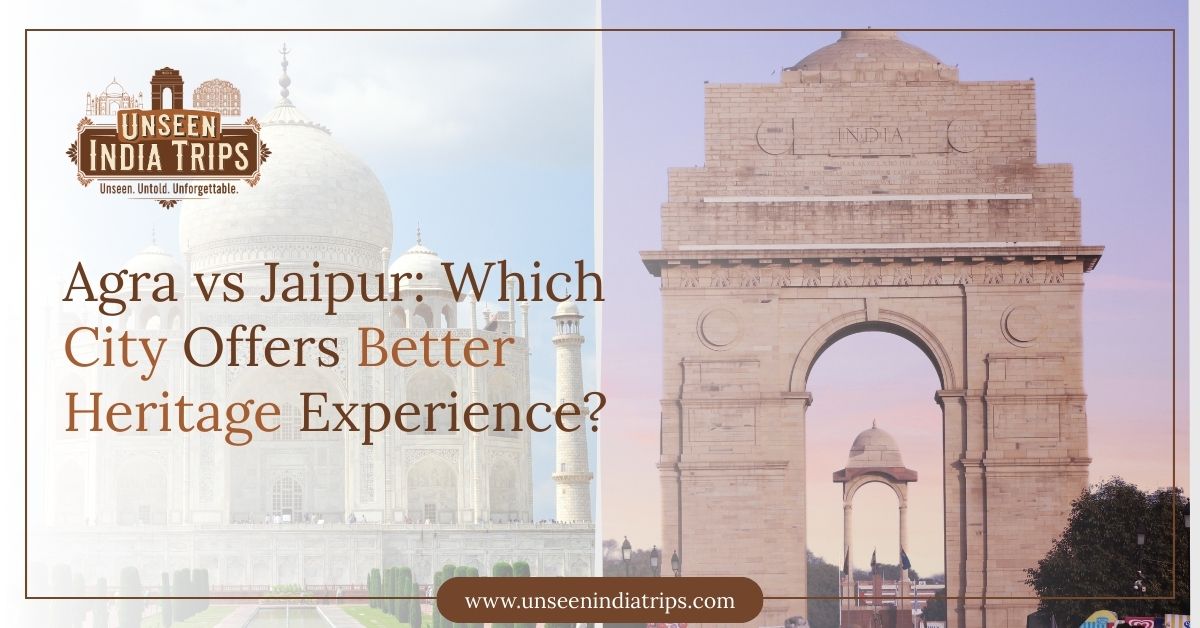
Agra’s Crown Jewel: The Taj Mahal dominates Agra’s heritage landscape so completely that the city’s identity remains inseparable from this architectural masterpiece. This UNESCO World Heritage Site, built by Emperor Shah Jahan as a mausoleum for his beloved wife Mumtaz Mahal, represents the pinnacle of Mughal architecture. The monument’s perfect symmetry, exquisite marble inlay work featuring semi-precious stones, and ethereal beauty create an experience that transcends typical sightseeing.
Beyond the Taj Mahal, Agra Fort stands as another UNESCO site offering insight into Mughal imperial life. This massive red sandstone fortress complex features palaces, audience halls, and mosques showcasing evolution from Akbar’s reign through Shah Jahan’s period. The fort’s strategic position on the Yamuna River provided defensive advantages while offering views toward the Taj Mahal—a poignant detail given Shah Jahan spent his final years imprisoned here, gazing at his creation.
Itmad-ud-Daulah, often called the “Baby Taj,” predates the Taj Mahal and features similar marble inlay work in a more intimate setting. Fatehpur Sikri, located 40 kilometers from Agra, represents a complete Mughal city abandoned after just 14 years, frozen in time with its palaces, mosques, and courtyards intact.
Jaipur’s Royal Diversity: Jaipur offers a broader range of architectural styles and periods. The City Palace complex remains partially inhabited by the royal family while sections serve as museums displaying royal artifacts, textiles, weapons, and manuscripts. The palace’s blend of Rajput and Mughal architecture reflects the sophisticated cultural synthesis achieved by Jaipur’s maharajas.
Amber Fort, located on a hillside overlooking Maota Lake, represents Rajput military architecture at its finest. The fort’s Sheesh Mahal (Mirror Palace) features thousands of tiny mirrors creating a mesmerizing effect when illuminated. The fort complex includes temples, gardens, and elaborate gateways, requiring several hours for thorough exploration.
Hawa Mahal’s distinctive facade with 953 small windows allowed royal women to observe street life while maintaining purdah. While the interior is modest, the exterior has become Jaipur’s most recognizable landmark. Nahargarh Fort provides panoramic city views and houses an interesting museum about Jaipur’s history.
Jantar Mantar, another UNESCO World Heritage Site, showcases astronomical instruments built by Maharaja Sawai Jai Singh II. These massive structures, including the world’s largest stone sundial, demonstrate the scientific sophistication of 18th-century India.
Verdict on Monuments: Agra wins on singular iconic impact. The Taj Mahal alone justifies the journey and represents one of humanity’s greatest architectural achievements. However, Jaipur offers greater diversity and quantity of heritage sites, providing a more comprehensive understanding of North Indian royal architecture and culture.
Historical Narratives
Agra’s Mughal Legacy: Agra’s heritage centers almost exclusively on the Mughal period, particularly the reigns of Akbar, Jahangir, and Shah Jahan. This focused historical narrative provides deep insight into one dynasty’s artistic and architectural achievements. The story told through Agra’s monuments revolves around imperial power, romantic devotion, and the eventual decline of Mughal authority.
Agra served as the Mughal capital during the empire’s zenith, and its monuments reflect that golden age. The concentration of Mughal architecture within a relatively small area creates an immersive experience in one specific historical period.
Jaipur’s Rajput Chronicle: Jaipur presents a longer and more varied historical narrative. Founded in 1727 by Maharaja Sawai Jai Singh II, the city represents one of India’s best examples of planned urban development from that era. The story extends beyond monuments to include urban planning principles based on Vastu Shastra and the integration of astronomy into architecture.
Jaipur’s heritage encompasses not just royal structures but also the living legacy of a continuing royal family, traditional crafts that have flourished for centuries, and cultural practices still maintained today. The narrative includes interactions between Rajput kingdoms and Mughal emperors, showing how Rajasthan’s rulers maintained identity while navigating larger political realities.
Verdict on Historical Depth: Jaipur offers more layered and continuous historical narratives, while Agra provides focused insight into the Mughal Empire’s peak period.
Living Heritage and Culture
Agra’s Present Character: Modern Agra functions primarily as a tourist city where heritage has been somewhat commodified. The city’s economy depends heavily on tourism centered around the Taj Mahal. While this ensures monument preservation and accessibility, it also means experiencing heritage somewhat removed from living culture.
Traditional Mughal crafts, particularly marble inlay work (pietra dura) and carpet weaving, continue in workshops throughout Agra. However, these often cater to tourist markets rather than representing genuine living traditions serving local communities.
Jaipur’s Living Traditions: Jaipur’s heritage remains vibrantly integrated into daily life. The royal family continues residing in City Palace, maintaining ceremonial and cultural roles. Traditional crafts—block printing, blue pottery, gem cutting, jewelry making, and textile production—flourish as genuine industries serving both local and global markets.
Bazaars like Johari Bazaar, Bapu Bazaar, and Chandpol Bazaar function as living heritage spaces where traditional trading patterns continue. Craftsmen work in workshops using techniques passed through generations. Jaipur’s heritage feels less like museum exhibits and more like a continuing cultural tradition adapting to modern times while retaining essential character.
Verdict on Living Heritage: Jaipur significantly surpasses Agra in maintaining living heritage integrated into contemporary life.
Accessibility and Tourist Infrastructure
Agra’s Focused Infrastructure: Agra’s compact heritage zone means major monuments sit relatively close together. Many travelers opt for an Agra one day tour package by car, which efficiently covers the Taj Mahal, Agra Fort, and potentially Itmad-ud-Daulah or Fatehpur Sikri in a single day. This convenience appeals to travelers with limited time.
The city’s tourism infrastructure focuses intensely on serving visitors efficiently. Hotels at all budget levels cluster near monuments. Guides, transportation, and support services are readily available, though persistent touts can be overwhelming around major sites.
Jaipur’s Spread-Out Sites: Jaipur’s monuments are more dispersed across the city. Amber Fort alone sits 11 kilometers from the city center. Comprehensive exploration requires multiple days and various transportation arrangements. However, this distribution means experiencing different neighborhoods and seeing how heritage integrates into urban fabric.
Jaipur offers superior accommodation options, from luxury heritage hotels converted from palaces to excellent boutique properties. The city’s larger size and role as Rajasthan’s capital ensures better restaurants, shopping, and services.
Verdict on Logistics: Agra wins for time-efficient heritage tourism; Jaipur requires more time but offers better overall infrastructure and comfort.
Photography Opportunities
Agra’s Iconic Images: The Taj Mahal provides endlessly rewarding photography subjects. Different lighting conditions throughout the day create varying moods and appearances. The reflecting pool creates classic symmetrical compositions, while details of inlay work reward macro photography.
Agra Fort’s red sandstone against blue skies provides strong color contrasts. However, photography opportunities center heavily on monuments themselves with limited street photography or cultural documentation opportunities.
Jaipur’s Diverse Subjects: Jaipur offers tremendous variety—architecture, street scenes, markets, traditional crafts, colorful textiles, and cultural activities. The pink sandstone architecture photographs beautifully against Rajasthan’s clear blue skies. Markets provide vibrant color and dynamic human subjects.
The city’s bazaars, craftsmen at work, and integration of heritage into daily life create opportunities for documentary and street photography beyond architectural shots.
Verdict on Photography: Agra provides iconic, portfolio-defining images of world-famous monuments. Jaipur offers greater variety and opportunities for comprehensive photographic storytelling.
Budget Considerations
Both cities offer accommodation and dining across budget ranges. Agra generally features slightly lower costs for equivalent quality. Entry fees for monuments are comparable, though Jaipur’s greater number of sites means higher cumulative costs for comprehensive exploration.
Many travelers choose Jaipur tour package options that bundle accommodations, transportation, and guided tours, often providing value through bulk arrangements and local expertise.
Time Investment
Agra: A focused traveler can cover major heritage sites in one full day, though two days allow more relaxed exploration including sunrise at the Taj Mahal, comprehensive Agra Fort exploration, and visiting secondary sites or Fatehpur Sikri.
Jaipur: Minimum two full days required for primary attractions. Three to four days ideal for including markets, craft workshops, and absorbing the city’s cultural ambiance without rushing.
Which City Wins?
The question ultimately lacks a universal answer because each city excels in different dimensions:
Choose Agra if you:
- Have limited time and want maximum heritage impact
- Prioritize seeing world-famous iconic monuments
- Prefer focused historical narratives
- Want efficient, compact sightseeing
- Are primarily interested in Mughal architecture
Choose Jaipur if you:
- Have time for extended exploration
- Value living cultural traditions alongside historic monuments
- Want diverse architectural styles and historical periods
- Enjoy experiencing heritage integrated into contemporary life
- Appreciate comprehensive urban heritage beyond individual monuments
- Want better shopping, dining, and accommodation options
The Ideal Solution: Visit both cities. They complement rather than compete with each other. The two cities together provide comprehensive understanding of North Indian heritage—Agra showcasing Mughal imperial achievement at its zenith, Jaipur demonstrating Rajput cultural sophistication and continuity.
Most travelers exploring India’s Golden Triangle include both cities for good reason. The journey between them takes only 4-5 hours by car, making them naturally complementary destinations in a single itinerary.
Conclusion
Declaring one city superior diminishes what makes each special. Agra offers the world’s most famous monument and focused insight into Mughal architectural genius. Jaipur provides diverse heritage experiences, living cultural traditions, and a more comfortable, varied urban environment. Both cities deserve space in any serious heritage itinerary through North India. The question isn’t which is better, but rather which aspects of Indian heritage most fascinate you—and ideally, making time to experience both perspectives on India’s magnificent royal and imperial past.